Capsule Security System
Capsule verification for safer digital identity, access, and data movement.
Atomic AI Nexus uses CAPPS, Capsule verification, AI Core monitoring, and Layer 6 isolation to create a protected trust layer for users, wallets, apps, projects, businesses, and settlement flows.
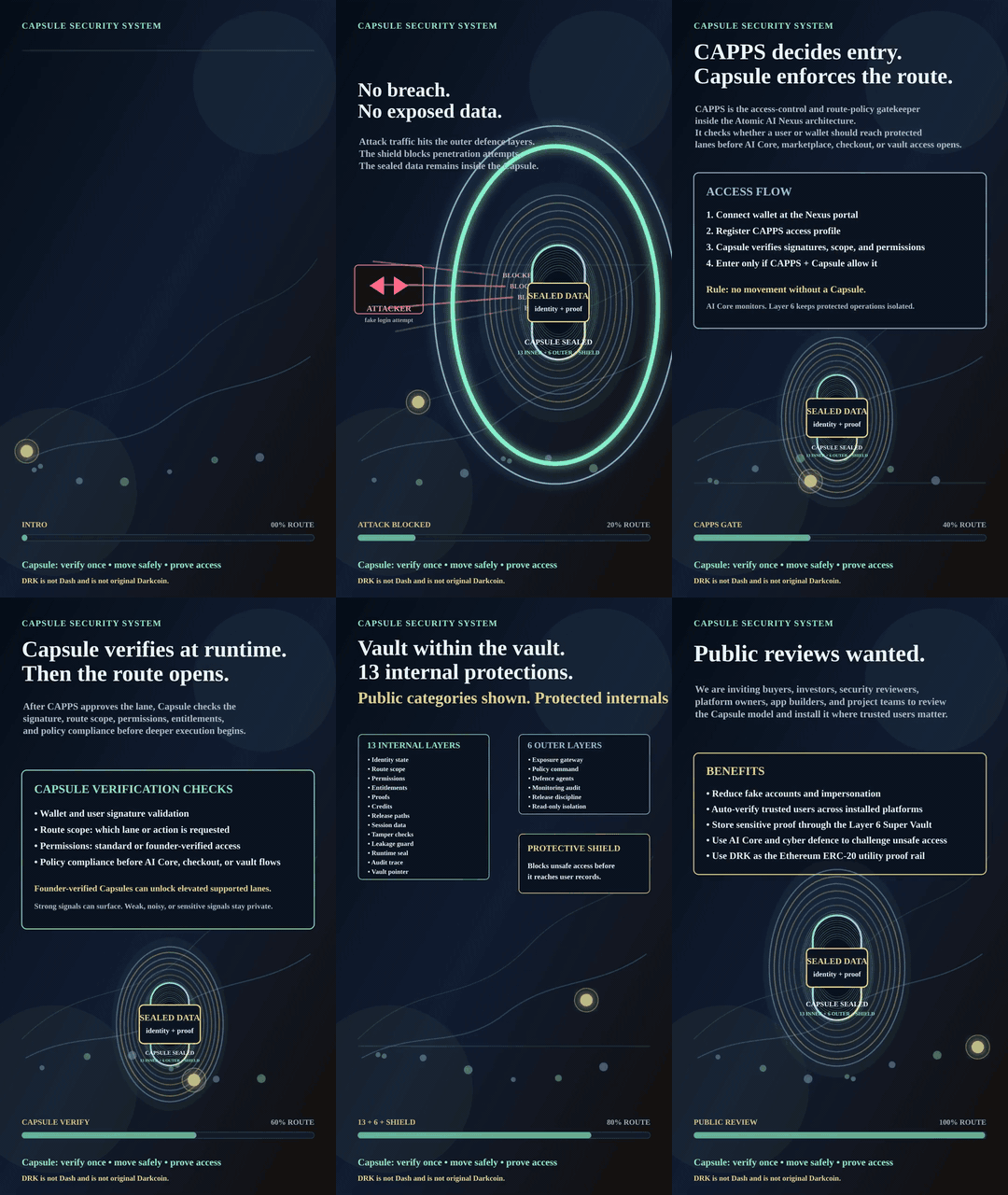
Introduction
A new verification layer for a web flooded with fake accounts.
Capsule is designed to reduce fake accounts, weak signups, repeated approvals, and uncontrolled route exposure by turning verification into a scoped, portable security object. A verified user, wallet, business, app, or project can move through supported Atomic AI routes with a Capsule instead of repeatedly exposing sensitive details at every checkpoint.
Verify once
CAPPS builds the access profile, Capsule validates the runtime request, and the route opens only when the correct proof, scope, and permission are present.
Move safely
The Capsule carries only scoped verification context across supported routes, reducing repeated exposure of identity and sensitive data.
Install trust rails
Apps, projects, and businesses can use the Capsule model as a controlled access gateway before protected routes, checkout flows, AI Core sessions, or private vault paths are reached.
Problem solved
Fake accounts are an access-control problem before they become a platform problem.
Most platforms still allow unknown visitors, weak wallet signals, repeated bot attempts, and incomplete account data to reach sensitive routes before enough checks happen. Capsule changes the order: access is evaluated first, verification is scoped, and protected routes stay closed until the user or wallet passes the correct policy boundary.
Less duplicate review
Verified Capsule context can be reused across supported lanes, reducing repeated manual approvals where policy allows.
Less public exposure
Sensitive details remain protected in the verification and vault model instead of being repeatedly sent through public routes.
Better route discipline
Public, protected, founder-verified, checkout, marketplace, and AI Core paths can use different scopes and permissions.
Audit-friendly evidence
Gate decisions, reviews, settlement events, and route approvals can be logged for review without exposing unnecessary private data.
Public beta notice
Evidence first. Guarded claims only.
This page explains the public architecture. It does not disclose protected implementation details, exact encryption order, private Layer 6 internals, private keys, or production-only controls. Status-only language remains in place until external reviews, live proofs, and production evidence are published.
Strong signals public
Architecture, route purpose, evidence pages, status, and public proof can be reviewed.
Sensitive details private
Exact mechanisms, algorithms, enforcement points, and private core internals remain protected.
Reviews wanted
Buyers, investors, app builders, project teams, and security reviewers are invited to review the model.
For businesses and apps
Install Capsule to put a narrow verification gateway in front of sensitive routes.
The business value is simple: only verified, scoped, entitled traffic should reach protected actions. Capsule is designed for apps, marketplaces, AI products, Web3 projects, checkout systems, community platforms, and private dashboards that need stronger verification without exposing every internal route to every visitor.
Access control
Use CAPPS and Capsule to decide who can enter public, protected, premium, founder, admin, marketplace, or checkout lanes.
Reusable verification
Once a Capsule is established, supported routes can verify scope and entitlement without starting from zero every time.
Reduced approval delay
Where a route policy allows it, Capsule evidence can reduce waiting time because the request already carries verified context.
Private data posture
Identity and route context are handled as scoped security information, with sensitive details kept away from public surfaces.
Buyer review path
Teams can review the architecture, book, public evidence pages, and beta status before discussing pilots or integration.
Partner-ready language
The page uses guarded public-beta wording so reviewers can evaluate claims without unsupported security guarantees.
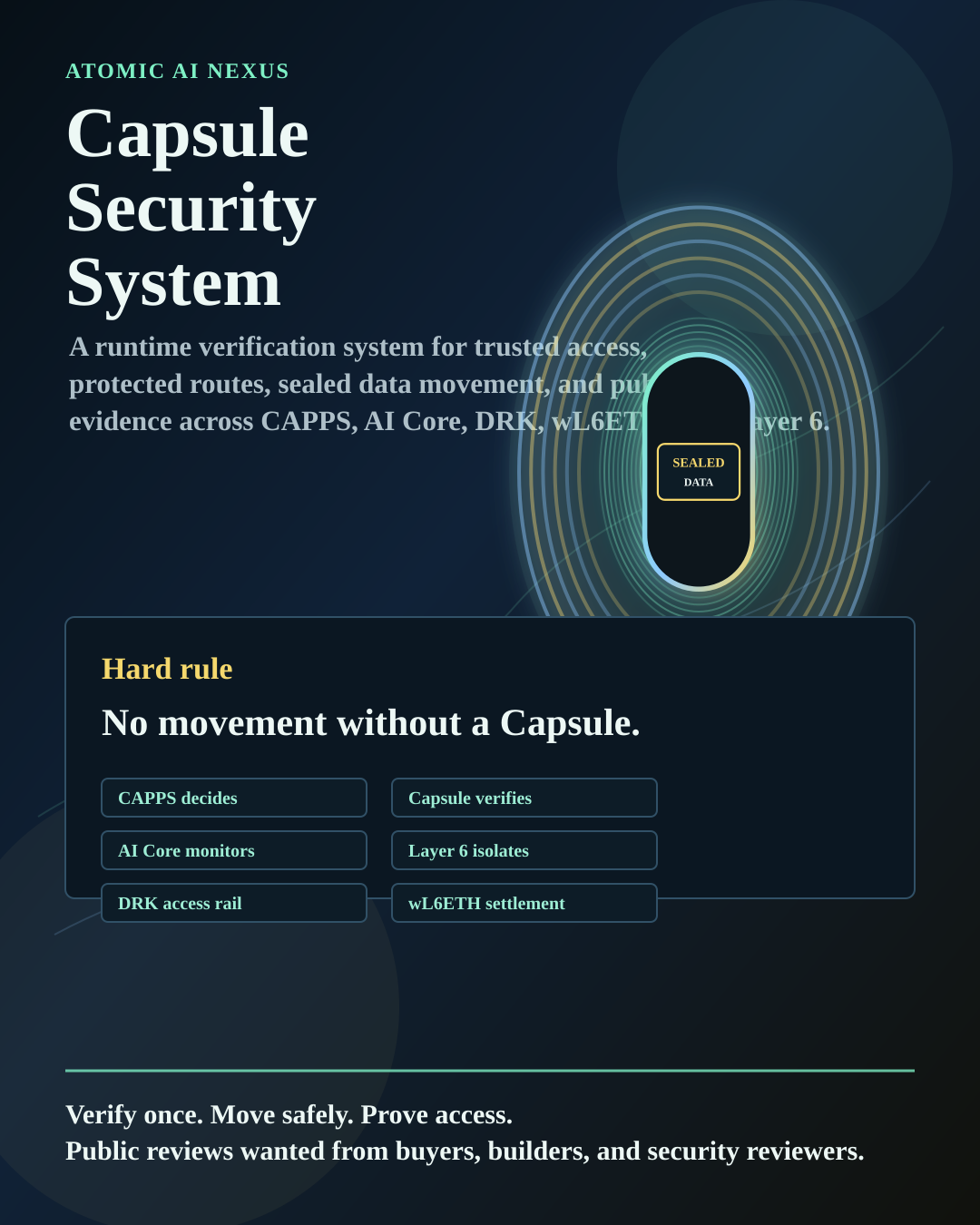
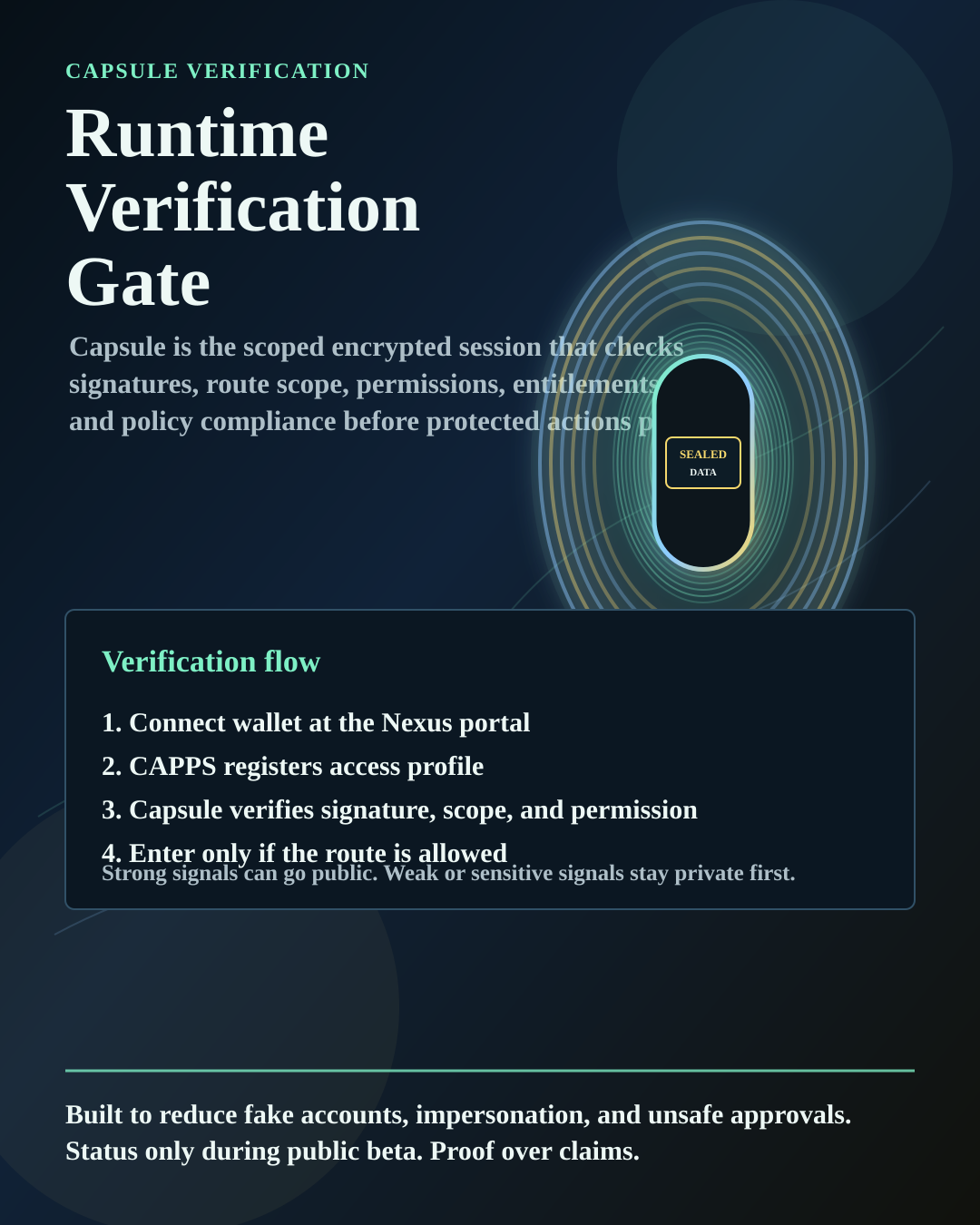
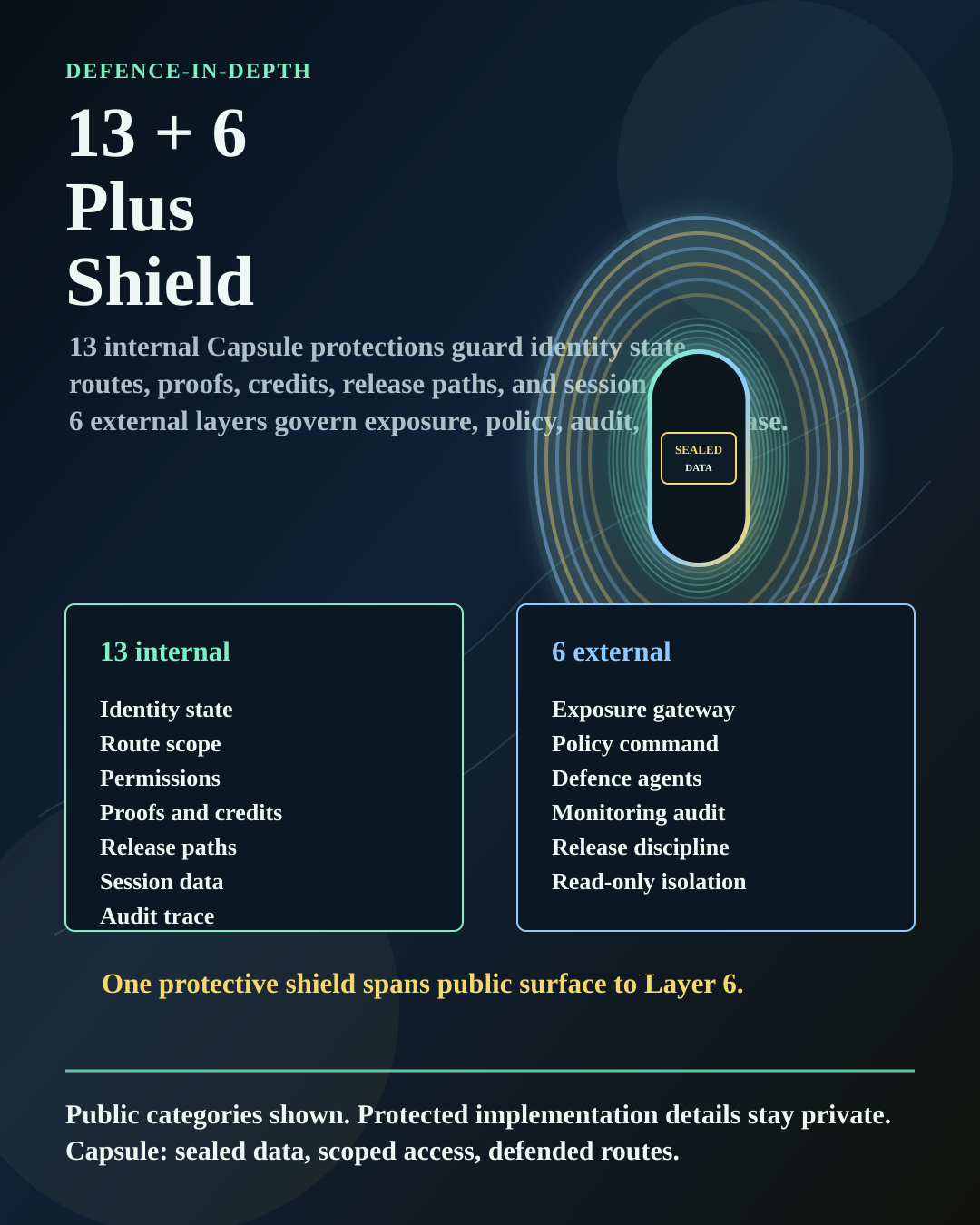
Poster pack
Public share assets for Capsule, Layer 6, DRK, and the book reveal.
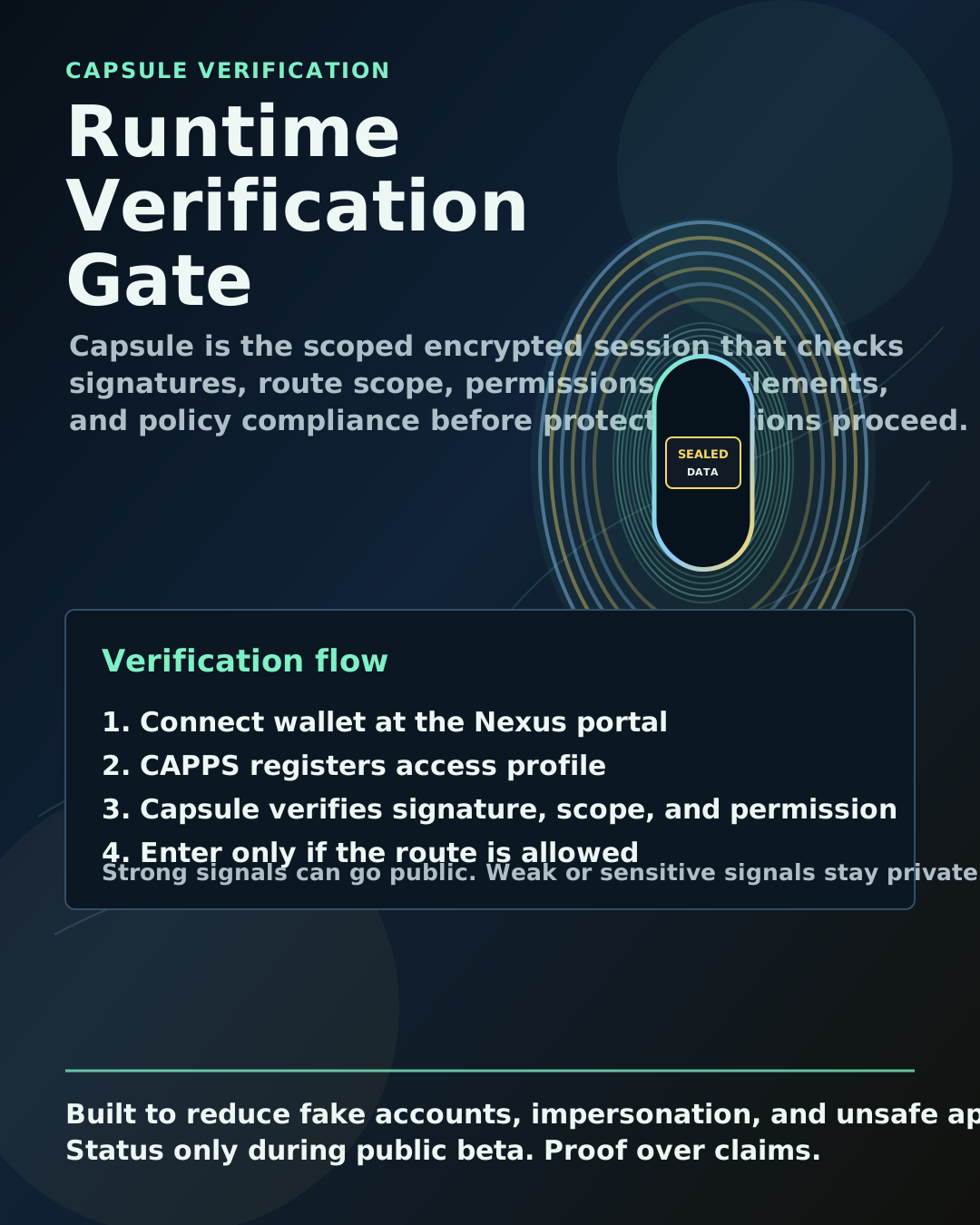
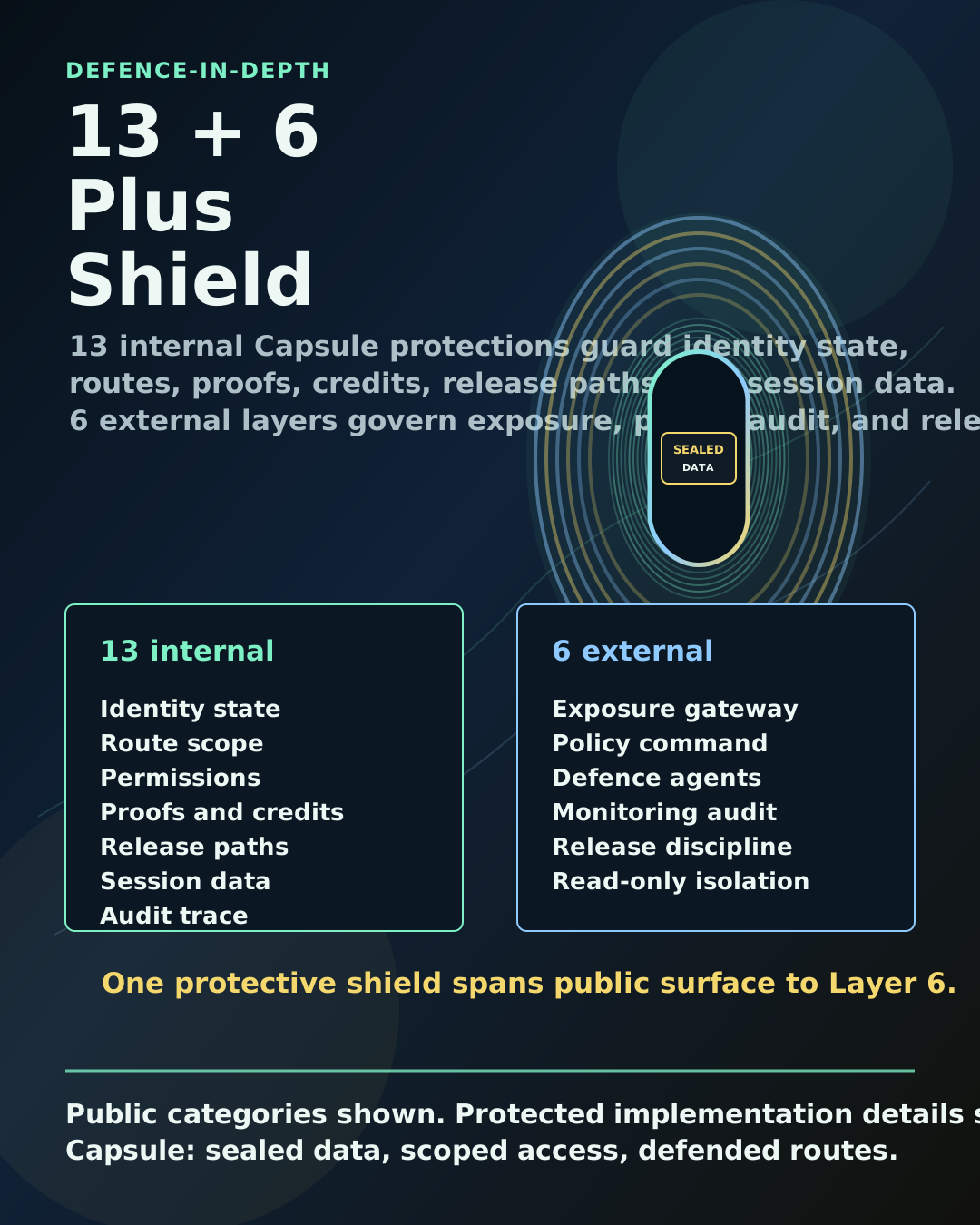
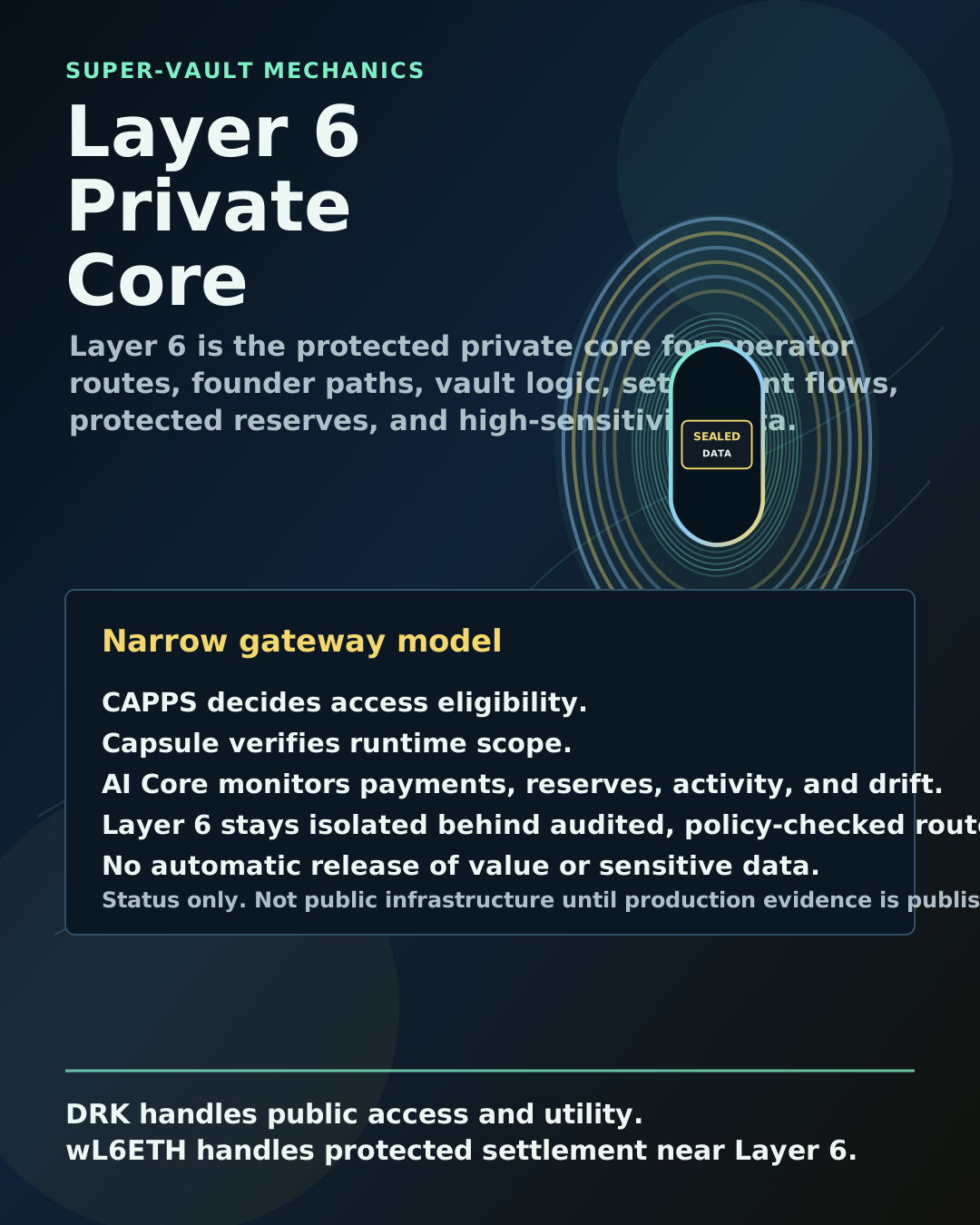
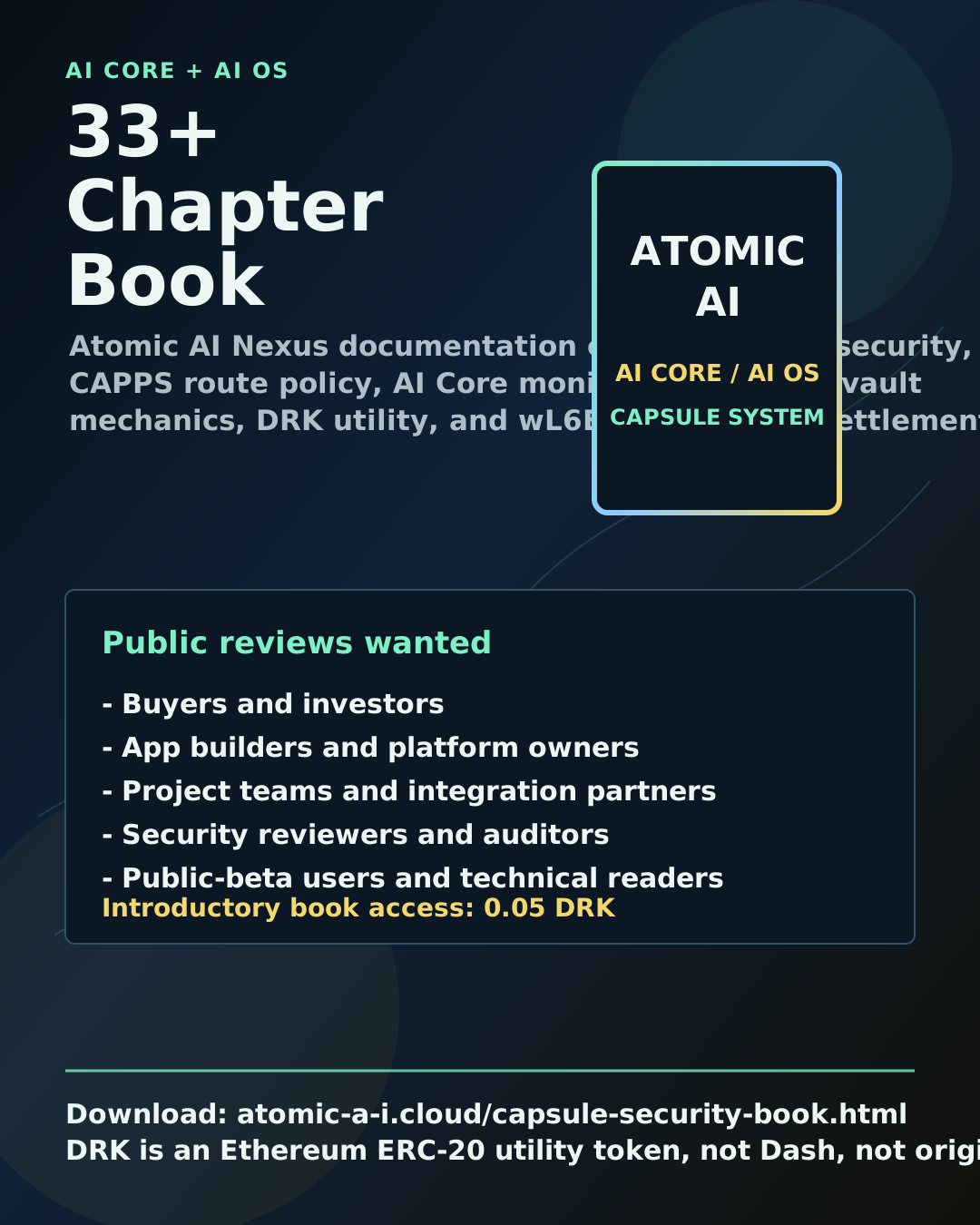
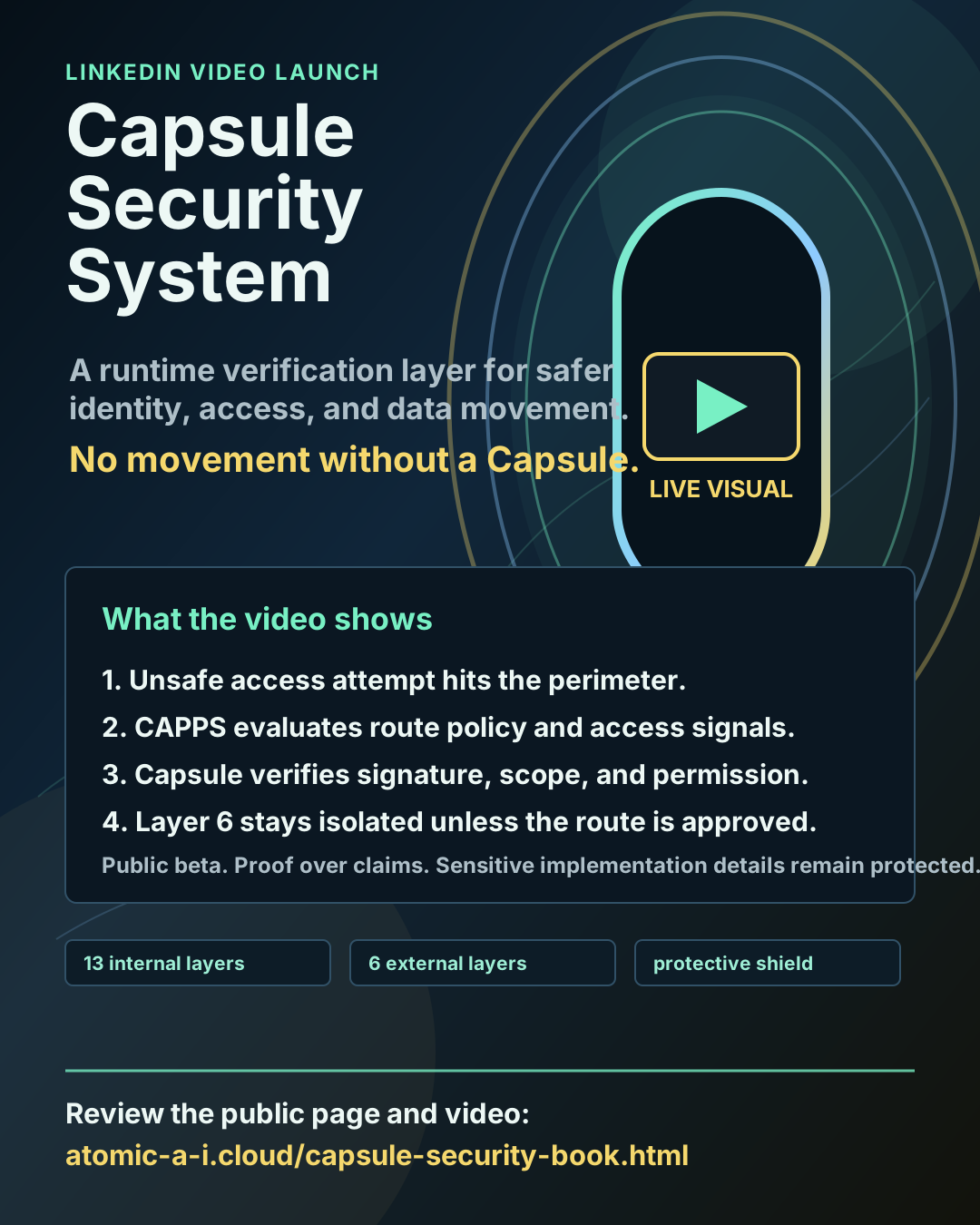
These posters are designed for public review posts across Twitter/X, LinkedIn, Reddit, and partner outreach. Each one uses guarded public-beta wording and points back to the same core message: Capsule verification protects access, data movement, and route policy before sensitive systems are reached.
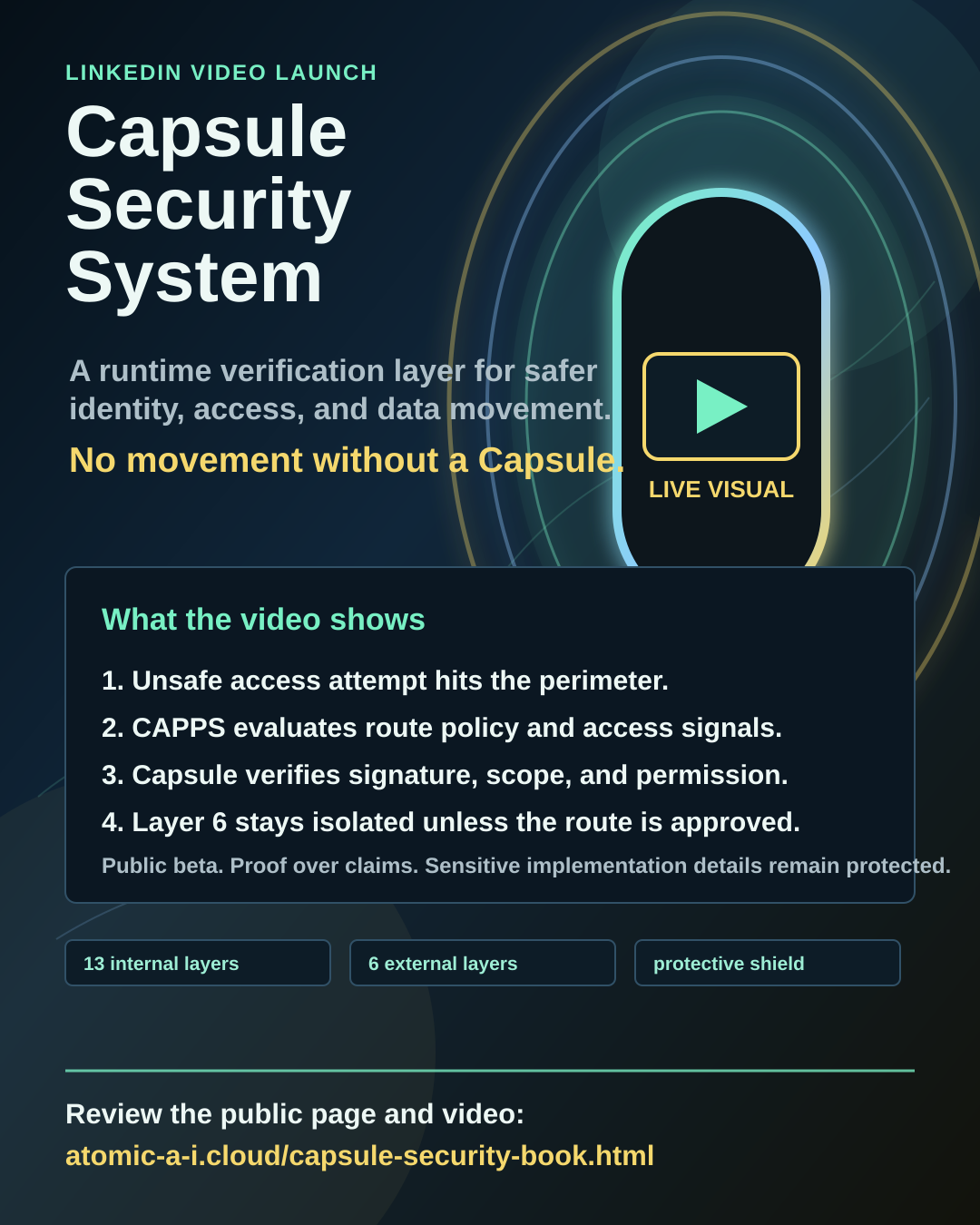
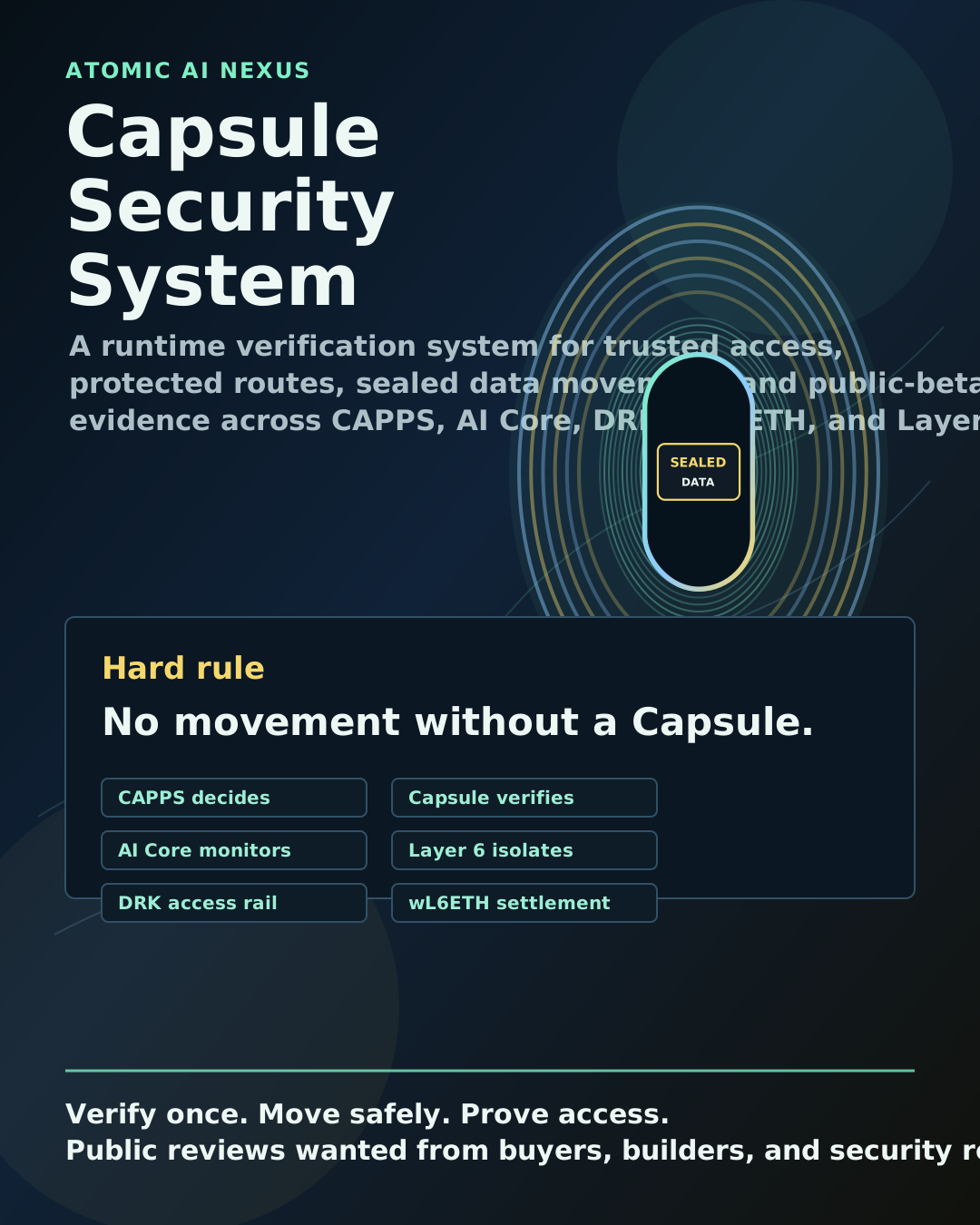
Complete poster folder
The public folder includes all PNG and SVG posters plus the poster index for quick review.
Data transport model
Origin to destination, inside a scoped security container.
Capsule is presented as a transport and verification model for moving sensitive context from an origin route to an approved destination route. The goal is not to expose everything everywhere. The goal is to move only what the route needs, under policy, with monitoring, review trails, and Layer 6 boundaries active around protected flows.
OriginUser, wallet, app, project, checkout, marketplace, AI Core session, or protected portal route
VerificationCAPPS profile, Capsule signature checks, route scope, permissions, entitlements, and policy compliance
TransportScoped Capsule context moves through approved routes under the protective shield
DestinationProtected route, Layer 6-adjacent service, AI Core lane, marketplace action, checkout proof, or review trail
Operational agents, monitors, and review trails support the flow. This should be described as actively monitored and maintained by the system, not as a zero-maintenance guarantee.
System flow
CAPPS decides. Capsule verifies. Layer 6 stays isolated.
1. Connect
User or wallet reaches the Nexus portal after reviewing public contracts, labels, status, and risk notes.
2. Register
CAPPS establishes an access profile for protected lanes and checks route policy, identity signals, and entitlements.
3. Verify
Capsule verifies signatures, route scope, permissions, entitlements, and policy compliance at runtime.
4. Enter
Protected routes open only if CAPPS and Capsule allow them. AI Core monitors activity around the route.
CAPPS
The policy brain for who gets in where.
CAPPS is the access-control and route-policy system in Atomic AI Nexus. It prevents indiscriminate exposure of protected product routes to every wallet or visitor. CAPPS decides whether a user or wallet should reach a protected lane before deeper access is granted.
Evaluates identity signals
Wallet or user signals, public evidence strength, weak/private signal handling, and route eligibility.
Checks sensitivity
Public route, protected lane, founder-verified route, AI Core session, marketplace action, or checkout path.
Separates concerns
Access and utility stay separate from protected settlement and Layer 6-sensitive value movement.
AI Core and cyber defence
Capsule-gated traffic is monitored before deeper systems are reached.
AI Core and the operational defence model sit around Capsule-gated flows to classify activity, watch route behaviour, support alerts, and preserve evidence. Attempts that do not carry the correct Capsule context should remain outside protected lanes rather than being allowed to explore internal systems.
Threat observation
Cyber-defence agents, red-team agents, scouts, and sentries are described as observing, probing, and responding to suspicious activity or drift.
Boundary enforcement
Requests that fail route policy, signature checks, scope checks, or permission checks should not reach deeper protected routes.
Evidence over claims
The public system should keep producing logs, status pages, review trails, and proof records as the beta matures.
Public reviews needed
Atomic AI is asking reviewers, buyers, and serious partners to inspect the system.
This page is built for public review. The project is preparing broader disclosure around the AI Core and AI OS book, Capsule security, CAPPS route policy, DRK utility, wL6ETH settlement separation, and Layer 6 private-core mechanics. Public review should focus on evidence, wording, boundaries, and integration readiness.
Security reviewers
Review access flow, boundary claims, Capsule scope, public evidence, audit posture, and disclosure discipline.
Platform owners
Assess whether Capsule can protect signup, checkout, protected dashboards, user verification, or premium routes.
Buyers and partners
Use the book, architecture page, and trust evidence pages to evaluate pilot, integration, or commercial fit.
Investors
Review the technology, risks, public-beta status, evidence trail, and guarded token language before any conversation.
Capsule verification
The scoped runtime security object.
Capsule verification is the runtime security step that must pass before protected routes or sensitive actions proceed. It checks signatures, route scope, permissions, entitlements, and policy compliance after CAPPS decides that a lane may be reachable.
Signature validation
Confirms the wallet or user signal belongs to the session requesting access.
Route scope
Checks which lane or action is being requested, so one Capsule does not open every route.
Permissions
Separates standard, founder-verified, beta, admin, and protected access levels.
Policy compliance
Rejects weak, noisy, or non-compliant requests before deeper execution starts.
13 internal layers
The vault-within-the-vault model inside each Capsule.
The 13 internal protection layers are public-facing categories, not a full disclosure of protected implementation details. They describe what the sealed Capsule boundary protects once verification succeeds.
Identity state
Protects verified user or wallet state without repeatedly exposing full identity details.
Route scope
Defines the route, lane, or sensitive action the Capsule is allowed to request.
Permissions
Checks what the verified user or wallet may do inside that route.
Entitlements
Stores qualifying rights such as standard access, founder-verified access, beta access, or route privileges.
Proofs
Carries scoped evidence that verification completed without becoming an exposed identity record.
Credits
Protects usage-related credits, limits, allowances, or access units consumed during a protected route.
Release paths
Controls how data, value, proof, or permission leaves the Capsule.
Session data
Secures temporary runtime state created during the Capsule session.
Tamper checks
Watches for altered scope, proof, permission, route, or session signals.
Leakage guard
Reduces unnecessary exposure of private data, route data, and operator paths.
Runtime seal
Binds the active checks together so the Capsule behaves as a sealed verification object.
Audit trace
Preserves evidence of requests, route decisions, approvals, rejections, and review actions.
Vault pointer
References protected Layer 6-related flows without exposing the private core directly.
6 external layers
The operational perimeter around the Capsule.
The 6 external defence layers operate outside the sealed Capsule boundary. They control exposure, enforce policy, supervise execution, monitor activity, and discipline any release of data, value, or session output.
Exposure and gateway control
Limits what public routes expose and what traffic can reach protected lanes.
Policy and command enforcement
Applies route checks, limits, alerts, and operating rules before sensitive boundaries open.
Operational defence agents
Cyber defence, red-team agents, scouts, and sentries observe, probe, and respond to threats or drift.
Monitoring and audit
Captures snapshots, gate decisions, route requests, review trail events, and public-beta evidence.
Release discipline
Controls when data, value, proof, credits, or outputs are allowed to leave a protected flow.
Isolation and read-only enforcement
Keeps private data sealed and limits public surfaces to safe read-only or status-only outputs where needed.
Protective shield
The continuous defensive envelope.
The overarching protective shield is the top-level boundary and coordination layer. It ties the 13 internal layers, 6 external layers, CAPPS policy, Capsule Gate, AI Core monitoring, and Layer 6 isolation into one protected route from public surface to private core.
SpansPublic surface -> portal -> policy gateway -> protected routes -> Layer 6 core
CoordinatesCAPPS, Capsule verification, AI Core monitoring, external defence, and Layer 6 vault boundaries
PreservesSeparation of concerns: DRK for public access and wL6ETH for protected settlement
RuleNo movement without a Capsule
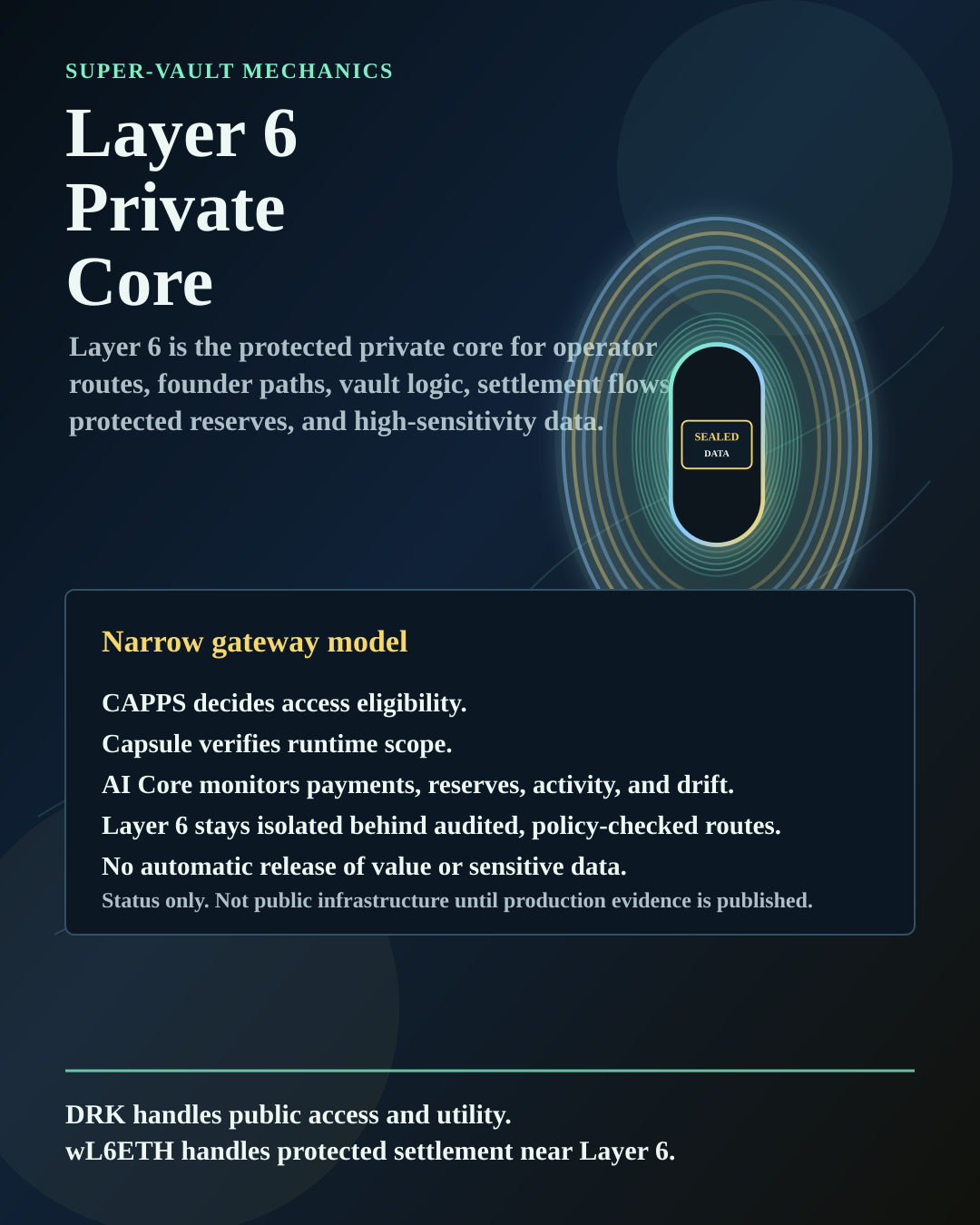
Layer 6
The protected private core.
Layer 6 is the innermost isolated component of the stack. Operator routes, founder paths, vault logic, protected reserves, settlement flows, sensitive services, and high-sensitivity data remain separated from the public surface.
Core isolation
Private data, scoped sessions, and sensitive logic remain sealed inside the Layer 6 boundary.
Narrow gateways
Layer 6 access occurs only through Capsule-verified, policy-checked relays.
No automatic release
Value or data movement requires explicit Capsule gating. Automatic release is disabled by default.
AI Core monitoring
Snapshots payments, spendability, reserve state, recent activity, and movements.
Command system
Maintains a coherent operating picture for checks, alerts, and limits before sensitive boundaries are reached.
Review trail
Requests, settlements, gate decisions, and monitored events leave audit evidence.
DRK and wL6ETH
Public utility and protected settlement stay separated.
DRK: public utility and access
DRK is the public-facing utility/access token for entry, AI Core sessions, priority, visible credits, proof drops, and general Nexus access. It is the visible public trust signal. DRK is not Dash and is not original Darkcoin.
wL6ETH: protected settlement
wL6ETH is the protected settlement rail for value movement, checkout, internal balances, reserves, and sensitive treasury-linked flows inside or near Layer 6.
Access and utilityDRK
Settlement and reserveswL6ETH
Settlement ruleNo settlement or value movement without a verified Capsule
Current statuswL6ETH mechanics remain status-only until production evidence is published
DRK tokenomics
Utility-first. Not an investment claim.
DRK, also called Dark Coin, is the public utility and access token for Atomic AI Nexus public beta. It is positioned as a usage rail for access, AI Core sessions, CAPPS context, Capsule-gated routes, evidence tracking, and future DRK.e bridge context. It should not be described as a price guarantee, investment product, or yield product.
Network
Ethereum ERC-20 utility token with 18 decimals.
Max supply
9,999,999,999,999,999 DRK theoretical cap. Circulating supply remains under review.
Identity boundary
DRK is not Dash and is not original Darkcoin.
Primary utility
AI Core access, public chat sessions, CAPPS routing context, Capsule-gated lanes, private receipt records, evidence tracking, and future Atomic Chain DRK.e context.
Revenue routing
Eligible premium/utility revenue model: 40% DRK buyback support after review, 40% locked treasury accumulation, 20% manual burn sink with transaction-linked evidence.
Supply caveat
Private receipt allocations, observed LP holdings, treasury, reserves, team, rewards, locked, and burned categories require evidence before a verified circulating figure is claimed.
BoundaryNo market-cap, price-floor, guaranteed liquidity, staking-yield, or redemption-value claims
StatusPublic beta. Proof over claims. Manual reviews and Capsule verification remain active.
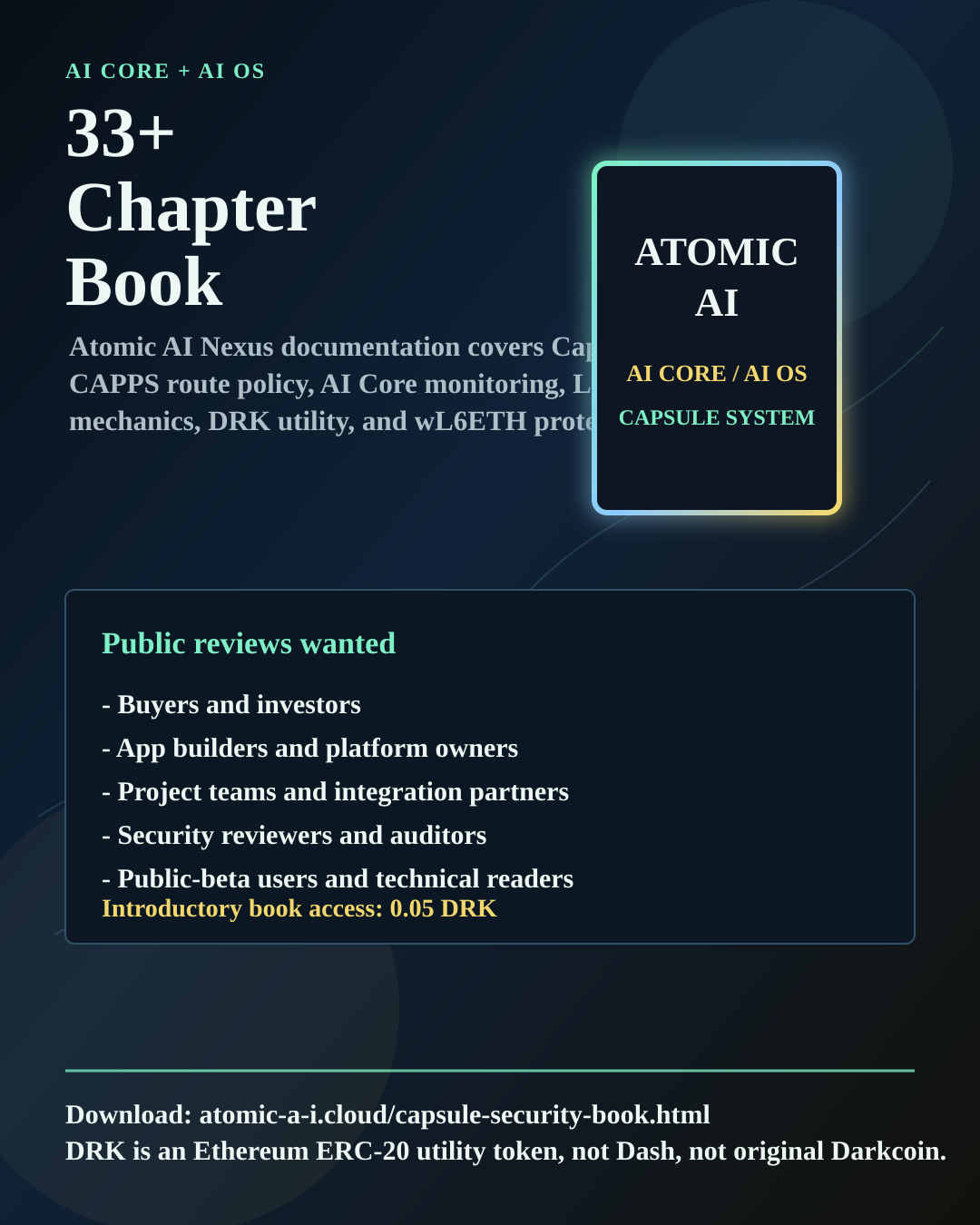
AI Core and AI OS book
33+ chapters documenting the system.
The Atomic AI Nexus book documents the AI Core, AI OS, Capsule model, CAPPS routing, Layer 6 protected core, DRK access rail, wL6ETH settlement rail, and public-beta trust architecture. The deeper mechanics remain protected where public disclosure would weaken the system.
Book price
Introductory public-beta access price: 0.05 DRK. The book is locked behind wallet payment and receipt review. Public pages explain the system; the PDF is not a free public download.
Who should review
Buyers, investors, app builders, platform owners, project teams, independent reviewers, and security professionals.
What to verify
Architecture clarity, route boundaries, evidence claims, status-only language, audit trail posture, and separation of public vs protected systems.